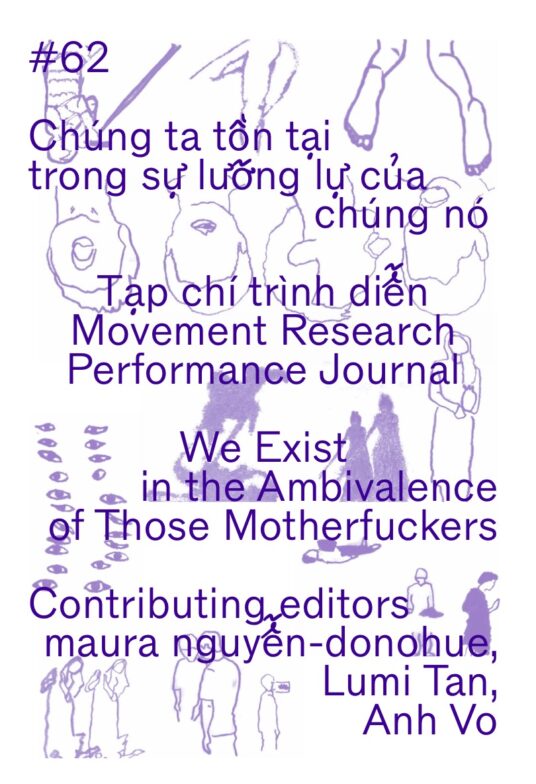
Our takeover of the 62nd issue of Movement Research Performance Journal is being released in tandem with We Exist in the Ambivalence of Those Motherfuckers, a program at Performance Space New York in January and February 2026 that invites four artists from Vietnam—Lại Diệu Hà, Vũ Đức Toàn, Nhi Lê, Đoàn Thanh Toàn—to be in residence and develop new performances. When we first gathered in summer 2024 around the vague idea of organizing a performance symposium addressing the fiftieth anniversary of the so-called ‘end’ of the Vietnam War in April of the following year, the project bore little resemblance to its present form. At the time, this definitive historical marker served as an opening for a broader reckoning with how war does not end but continues to live on in everyone, everywhere, like ambient weather. This understanding sharpened in real time as students across American campuses protested Israel’s genocide in Gaza, reactivating the anti- war movements forged in response to the United States’ destruction of Vietnam in the 1960s and 1970s.
In January 2025, our thinking shifted after moving between Hanoi and Saigon, which was less of a formal research trip than a deliberate overlap of our individual trajectories. We were already moving between Vietnam and the United States, be it on sabbatical, on separate re- search paths, or on returns that were personal as much as professional. Out of this calculated chance, we chose to follow the lead of the artists we encountered there—three generations of performers working un- der unpredictable pressures of socio-economic upheaval and cultural censorship. While a publication to accompany the residency program was always part of the plan, the question became more urgent: If only a few artists could travel to New York, what context would be missing and what history were we—in various positions of outsider-ness— re- sponsible for communicating?
We are neither approaching what is missing with paranoia nor with a compulsive desire to make a comprehensive survey of experimental Vietnamese performance. Here, absence has a material presence; it carves out a poetic space for intuition, an invitation to inquiry rather than a mandate to identify and fill gaps. This methodological orientation reflects the historical conditions under which many performances in Vietnam circulate. They are often sparsely documented, if at all, and their afterlives persist through stories and gossip, not stable archival records. Our research process attends to these fragments and hearsay, and to the impossibility of holding these relationships, spaces, or events in any fixed moment. This journal began with a diasporic ambition to do an intergenerational project that would center Vietnamese, in lieu of Vietnamese-American, practices. Resisting the impulse of simply bringing ‘Vietnam’ here, we hope to center the conversation and the time conversations take to build, as well as to ask: What are we actually in conversation with and what might the future hold in response?
This project itself begins mid-gesture. It picks up traces laid down through maura’s earlier exchanges with performance makers in Vietnam during The Mekong Project (2001-2005), organized by Dance Theater Workshop and funded primarily by the Rockefeller Foundation. It was a period of intensive relationship-building that unfolded in the wake of Đổi Mới (literally translated as “Changing New”), the 1986 open-door reforms that initiated Vietnam’s shift toward a market economy and international integration. The early 2000s carried a palpable sense of creative possibility, aligned with the country’s focus on economic progress. Experimental performance in Vietnam was thriving in this moment, in part because the ephemeral quality of liveness promises a sense of freedom—from the two-dimensional frame of the visual arts and, more critically, from state bureaucracy, censorship, and nationalist aesthetic mandates.
Two decades later, what once felt like an explosive moment of possibility did not unfold into a steady expansion of creative risk-taking. Instead, artists now work within an environment shaped by intensified surveillance and the withdrawal of international funding that once fueled local experimentation. Under these conditions, experimental performance becomes increasingly fugitive, circulating through decentralized underground networks with no sustainable infrastructure.
Working amid these conditions required an approach less concerned with visibility than with how information might be received, held, and carried forward. If the residencies at Performance Space New York are at the core of the project, what you are holding is one part of the broader effort to activate an entire ecosystem of programming around them. Ahead of the four artists’ arrival in January 2026, we worked to prepare a community to receive them—not only as an audience but as thought partners, peers, and kindred accomplices in the fight for curiosity, renegade imaginations, and free expression. Through conversations, presentations, screenings, and writings across multiple sites around the city, this project has unfolded as a many-limbed process, shaped as much by quiet exchanges as by public-facing events.
This issue is a tangible document that allows readers and audiences to connect with the constellations of experiences and perspectives from which the visiting artists have built their practices. We invited twenty-one Vietnamese artists, curators, and organizers engaged in experimental performance to contribute reflections on their own work, on historical spaces, performances, and events, or on present concerns. The issue is organized into four sections, structured by a loose sense of temporality and a light relationship to geography. These are not fixed categories or authoritative frames, but provisional groupings that give shape to our own ever-evolving research process, moving across decades and diasporas. This collection of texts was built relationally, curated and edited in kinship. It emerges from an abundant manifestation of duyên, the Vietnamese belief in fated affinity, where destiny, serendipity, and non-attachment do not promise ease necessarily, but allow for flow and connection. We refuse historical authority, and instead choose to operate in the realms of memory and embodiment. You will neither find a glossary nor appendices for the contributors’ references.
Some notes on translation: Vietnamese is a tonal language, in which a single word can hold several distinct meanings. Unlike neighboring countries, it uses a Romanized alphabet but does not mark tenses, placing translations through multivalenced refractions of meaning and requiring events to be understood through broader relational contexts rather than fixed linear timelines. Certain pieces were written only in English, as many of the terms related to performance, avant-garde practices, and experimentation were, and continue to be, imports without Vietnamese equivalents. The language one uses to think through concepts reveals not only paths of migration and transmission, but also hierarchies of value that determine what kind of responses are possible.
We invite readers to engage with this issue as a contingent mid-point, bearing the imprints of developing relationships and partial encounters, and open to being taken up and reworked elsewhere. We are grateful for the thought partners of the MRPJ editors, Joshua Lubin-Levy, John Arthur Peetz, and Nicole Bradbury, and John Philip Sage and Carlos Romo-Melgar of spreeeng design, who have embraced and steered the complexities of the process and each individual piece with attention, sensitivity, and ingenuity.
– maura nguyễn-donohue, Lumi Tan, Anh Vo