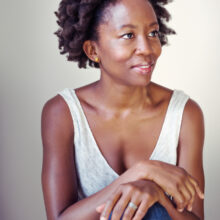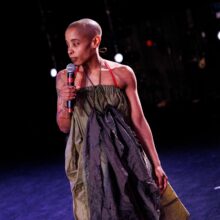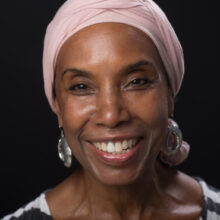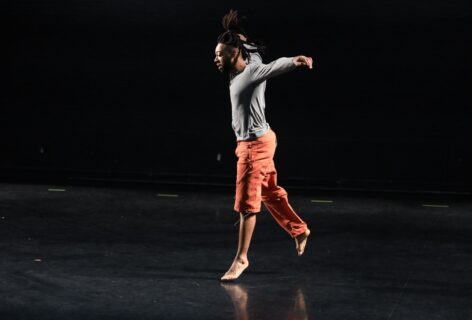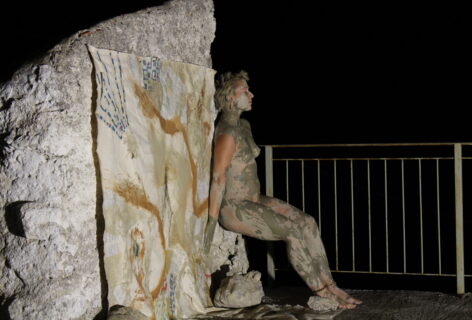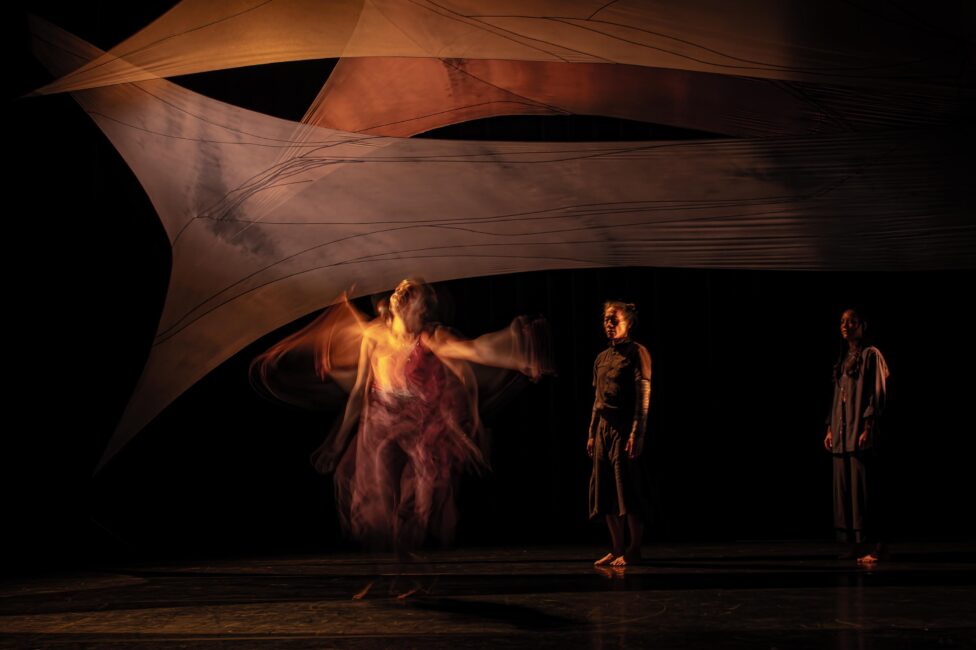
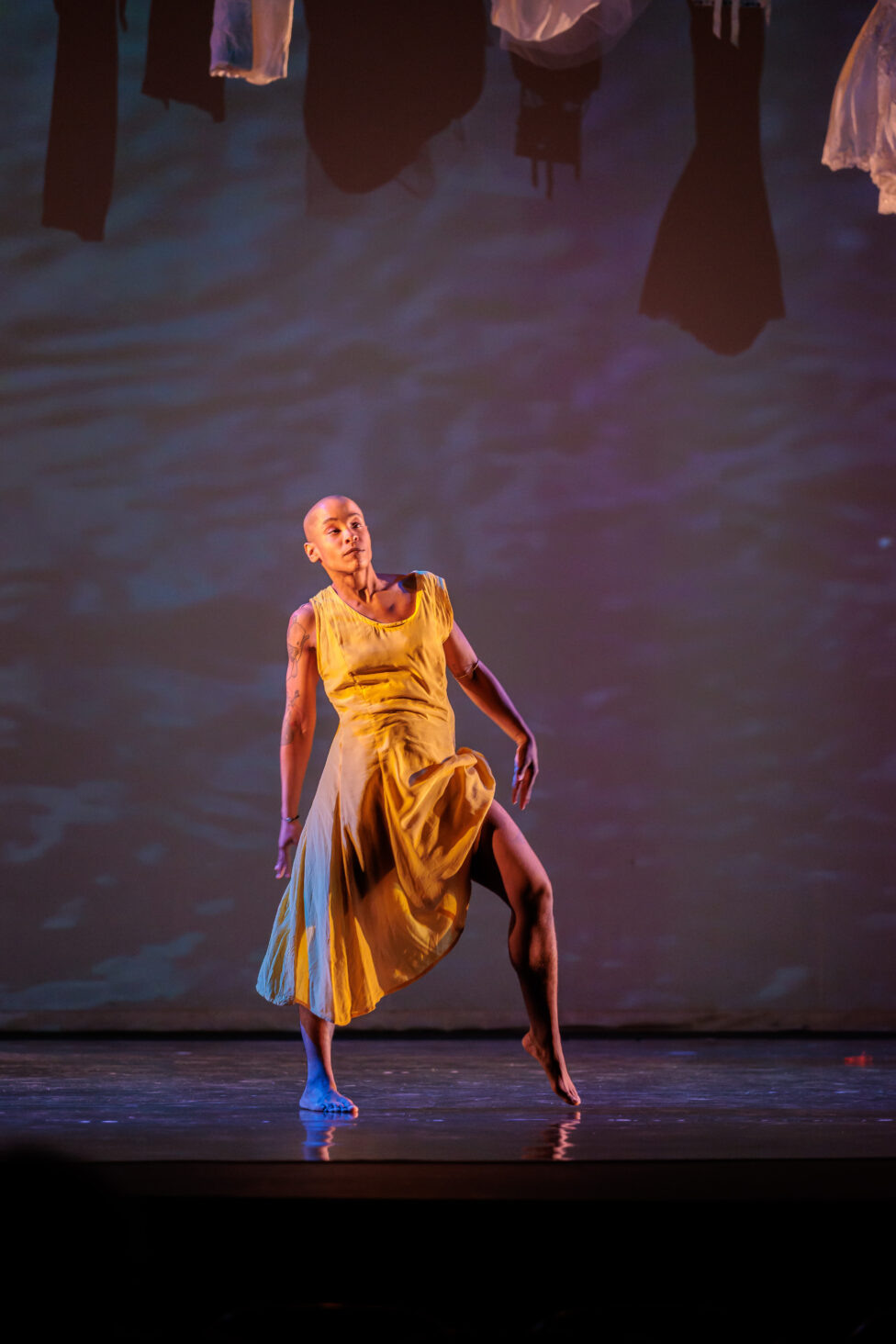
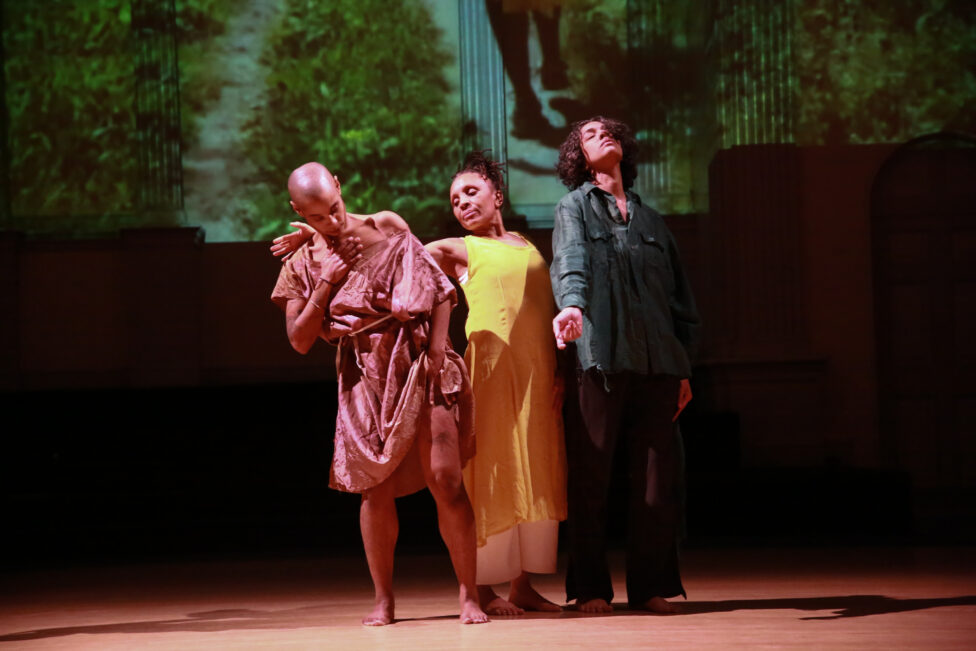
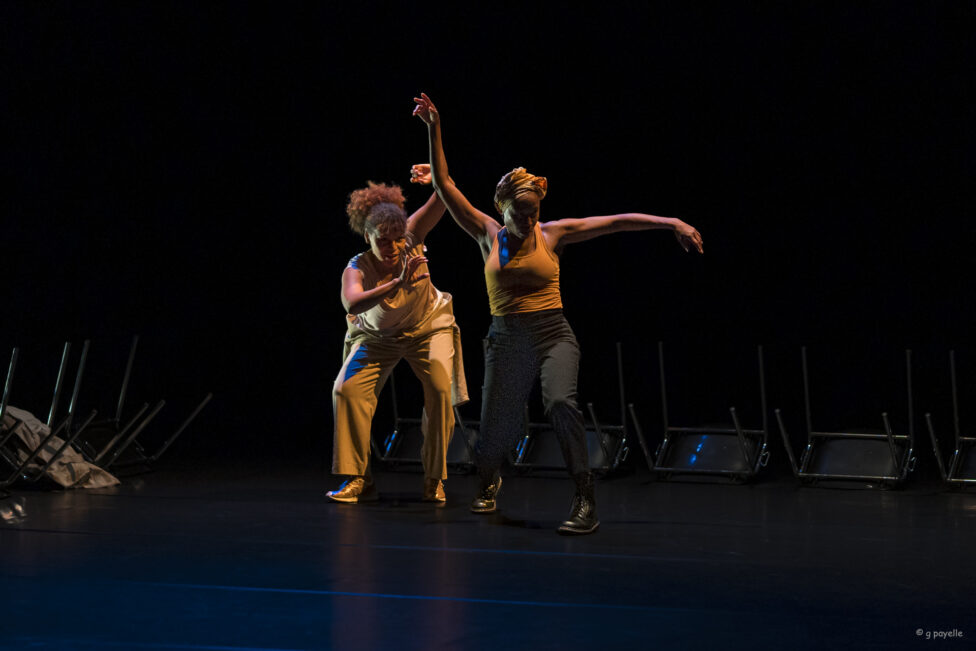
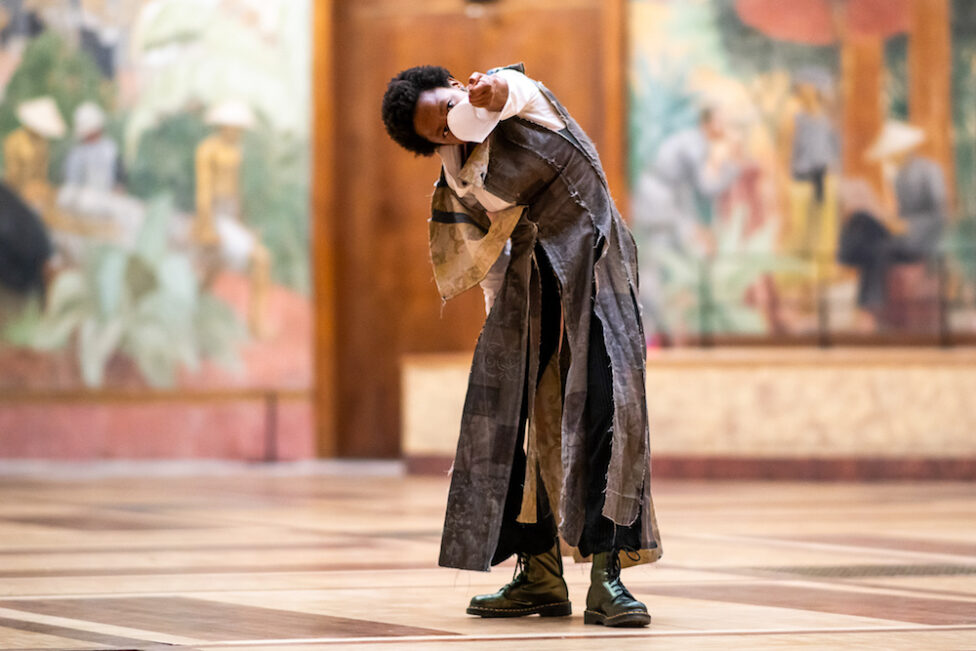
Jasmine Hearn is a self-described dancer, performer, choreographer, interdisciplinary artist, doula, memory keeper and organizer, who’s from mothers, aunties, and teachers on lands now known as Houston TX. A former company member of Urban Bush Women, they have immersed themself in a migratory, 10-year project, Memory Fleet, that recalls and honors the people and places who have profoundly influenced the artist they have become.
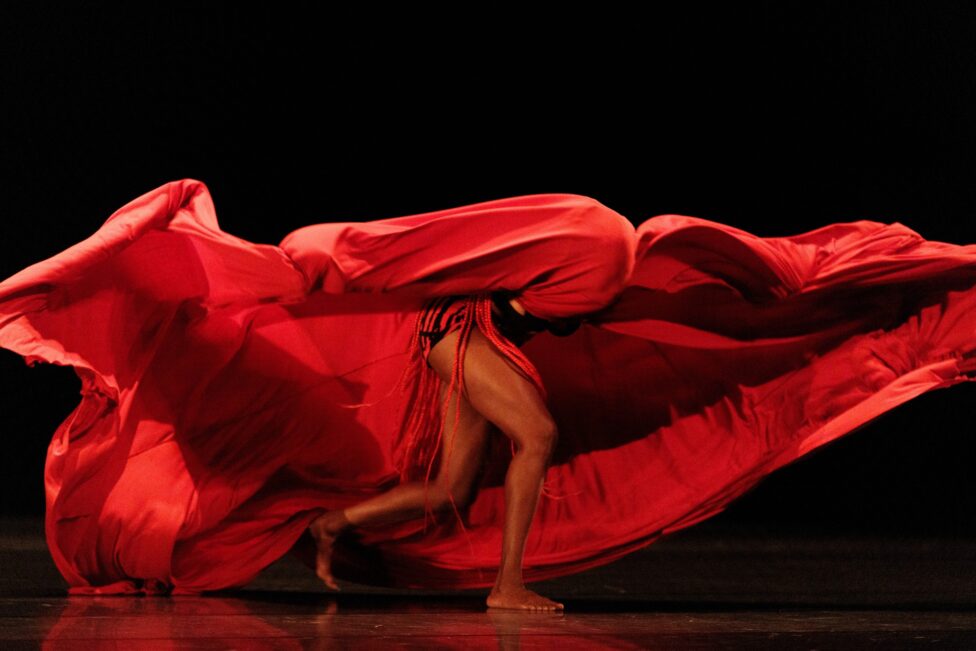
Wanjiru Kamuyu is a self-described choreographer, a performer born and raised in Kenya, and resident of Michigan by age 16. She performed for 6 seasons with Urban Bush Women, was in the original casts of the Paris production of The Lion King and London production of FELA!, and is currently living and making work in Paris. She recently premiered her first group piece, Fragmented Shadows at NYLA in October 2025, an abstract exploration of trauma and healing as they morph and mutate in bodies across generations.
I lured these two arresting movement artists into conversation with one another due to my curiosity about the affinities and intersections between their distinctive styles of engagement with stories of the Black diaspora and their intricate mappings of ancestry and lineage. Although they had never met before, their conversation took on the quality of kindred travelers—calling and responding, affirming and embellishing, probing and expanding—until I interrupted them after more than an hour. This transcript, edited for length and clarity, captures only a third of their rich and inspiring exchange.
-Germaine Ingram, CC guest editor
This article has been edited for the purpose of publication.
Jasmine Hearn
I was surrounded by imagery and video as you were preparing for your show [Fragmented Shadows, performed at NYLA in October 2025]. And there was this specific trailer that I had been witnessing often about you talking about the work and the rigor. What is your relationship to rigorous practice? In that video you were sweating —sweat to me holds such a deep connection to water memory and ways of receiving information from spirit and also… and also…. and also. So I was curious.
Wanjiru Kamuyu
I think the rigor comes from coming from a family that is anchored in really trying to unearth that which we’re committed to with our full being. It also comes from being trained as a dancer in a very rigorous, codified dance form. I started out with [more] creative movement, and then I moved into ballet, which is extremely rigorous and disciplined. With my personality, I just like to sink my teeth into something, and I like to go as deep as I can. For Fragmented Shadows, I remember doing research while on a Villa Albertine residency that’s based in the US [a culture and education institute within the French Embassy in the United States], and having coffee with Dr. Brenda Dixon Gottschild. I remember telling her, ‘I think I’m at the end of my rope with the research. Now I have to go into the studio and start to move through the body because at some point I felt oversaturated with information. I then need to excavate it and release it and turn it into a movement language for myself.’ So the rigor is really in the curiosity of what I am excavating, what I’m unearthing, what I’m trying to bring to light, what I’m trying to investigate and explore. Part of rigor is also to be as super clear as possible with those I collaborate with because if I’m not clear, then they’ll never be clear.
That work [Fragmented Shadows] is rooted in epigenetic science and psychosomatic practices, which is really quite interesting. It’s my first project where I actually talked to scientists to really get their take on lived-in and trans-generational experience and memories that live within our bodies. How does that affect our body? How does that create disease? Or in French, they would say maladie. My question to them was, how can we use movement as a vector for healing justice work? So it was really interesting to dive into it.
JH
Wow. I have way more questions, but I kind of want to pause to see if we want to do an exchange.
WK
We can because I think we have very common spaces where we dive into work and we excavate memory—memory is something that drives our work. I’m curious where the fascination developed for you. Where did that ignite for you? And you’re a doula, I thought that was so interesting. How has the doula experience nourished your excavation of memory and tapping into memory. What then comes out of that? What are you seeking behind this gathering of information, investigation, exploration?
JH
I would say it always returns me back to my grandmother, my maternal grandmother, and being able to be raised by my mother and her, and additional womb-holders in my family. There is something about my grandmother specifically, with both my mother and my grandmother sitting in the passenger seat in the car… Houston, Texas is a city where you drive. I try to walk it and people think I’m wild when I do it. Being their copilot, to sit and listen to how they navigate, how they get us from place to place, that has always been a space that I love to be in, and also a place that I inherited, thank goodness. Also with my grandmother, in 2015, I wanted to hear more about how she grew up in rural Texas in the 1930s. So I felt inclined, not only by my curiosity, but also by spirit, to ask her questions. And two years after we made a duet together, she was diagnosed with dementia.
WK
Wow, what a gift.
JH
This way of being led by intuition and to also yield…yield to some of my own kind of cravings, of wanting to be somewhere else in the dance world, in the dance field, to return back to who I came from, and to listen alongside. That has been the seed of why I continue to make what it is that I get a chance to make. And so that was the technology that she shared with me—- how to listen, and then also how to respond and create an interdisciplinary dance that can be shared around the country. I wanted to expand that, and over the past 10 years, I’ve been deepening as well as expanding with an incredible constellation of collaborators.
Jawole Willa Jo Zollar [Founding Artistic Director of Urban Bush Women], as you know being a part of the “Bush”, has always reminded me that the genius in the room is something we can rely on, and that, I myself will never hold it all, so why not surrender to the brilliance that other folks hold? I continue to return back to my grandmother and my mother, and to listen to the multitude of choreographies of resilience and care that have been taught to me by my mother, who’s a nurse, by my sister, who’s a physical therapist. And I, too, wanted to receive additional training to work in care practices, so I trained as a doula for full-spectrum birthing. I realized that I was more in alignment with death and end of cycle doula work.
WK
Wow, my sister, Wanjikũ, is a chaplain at a hospital in Chicago, and her life’s work is to see people through their last transition. I don’t know how y’all do it. Wow, it’s heavy. It’s a lot to carry, you know?
JH
It is, and I feel like it’s such a privilege.
WK
That’s what she says. Yeah, it’s a gift. It’s a privilege. And she sees a psychologist because, at some point, you have to release as well. But yeah, hats off. It’s a lot.
JH
And when you were naming your process of research—being at a certain point or boundary edge and then going into the studio, do you feel that you return back to researching? Or do you feel like it is pretty consistent within your creative process, to saturate yourself with research, and then move into the studio?
WK
Yeah, I think I bounce. So I have the collection of archival work that’s been researched, and then I go into the studio with that information. Sometimes I [do] go back and lean into it. Like for Fragmented Shadows, I did want something that was also beautiful and that we could manipulate in terms of decor. So I went back and looked at forms and textures influenced by epigenetic science—the inside of our body, fascia, tendons, ligaments. Also looking at the ocean and creatures within the ocean, to create some kind of tapestry and inspiration from those kinds of things. So yes, I do go back into the research as well, so that I can pull from it anew. And sometimes I need to leave it be and just release, let it breathe, and then come back into it. So yeah, I bounce. What do you do?
JH
I feel like I always have to move. And so I’ve been learning a lot from my teachers, especially. I had a chance to work with Bebe Miller, and be in so different improvisation scores of hers. She would really tell me, “Jasmine, just wait, just wait, be still for a minute.” I was like, “right, you’re right. Thank you—not only for folks to catch up with you, but for you to also receive.” So I’ve been really intentionally taking more time to be still over this past year.
In 2019, I moved out of a housing situation, and, since then, I was on the go. I had different places, different homes because folks have been so generous with their homes and have made space for me to be there in Houston and Pittsburgh and New York. I really was carrying most of my belongings on my body and traveling from place to place. A kind of freedom, in another way, it’s a kind of responsibility to improvise all the time. I was able to go where I was called, go where I was invited. I felt I was receiving such information, and then having opportunities to perform with the information that I brought in, but also the information that was immediately being shared. So there’s a lot of layering that happens. I understand that it can be a little unclear. It’s very non-linear.
WK
You know, when you mentioned stillness, I thought of a work [“An Immigrant’s Story”] I did during COVID. I was creating a solo work. I remember having an artist block. I remember my sweetheart, Cyril, saying, “well, you know, you should just stop and take a walk.” But I’m in a studio, and I have this guilt of being unproductive. I have this studio space and another choreographer could benefit from it. So I’m learning more and more to just allow the stillness to be, and that creativity is not just being in a studio or moving the body all the time. It’s also about just being in a space that inspires you and just letting the information fall into your spirit… Even the title for Fragmented Shadows—I was at PS 21 (Center for Contemporary Performance) in Chatham, New York. And one evening, I just sat on a swing and I looked at the sunset. And the title came. There was no extra effort. There was stillness, and there was beauty, and there was a deer, and then the name came. So I’m trying to listen to that and allow myself some more breathing room. There’s a lesson on and in stillness.
JH
And so I have a curiosity, a question for you—-it relates to how you’ve been able to move through different forms of dance throughout your life. I’m curious what lineages do you understand that you are a part of, whether they’re inherited and/or chosen?
WK
I would say I started with Creative Movement with Barbara Harmon in Kenya, and then Mrs. Haddad with ballet. Ballet I fell in love with, and I thought that’s what was going to be my movement form for life. Then, when we moved to the States, I was introduced to, and encountered modern dance—Horton and Graham and other codified forms. A little bit of jazz and some tap dancing. And then when I actually encountered movements that came from the African continent—it was actually in the diaspora—it was in the US, which I love to share. People think “oh, you were born in Africa, so then you were doing African dances…” No, no, unfortunately, that’s not the case. With Urban Bush Women, I was able to sink my teeth into deeper spaces of diasporic movement forms which really nourishes my work today.
And I remember having a tug of war at one point—early, early, before I even started professionally. I remember while I was in training at Ailey, having this tug of war with “what is dance?” What is considered dance for real? Is ballet “the high art”, or, what if I love Sabar? Isn’t Sabar also considered a valuable dance form? Can’t I concentrate on that and be valuable? But at the time, I was surrounded by an environment that pointed to ballet as the answer and to Sabar as the release that you just do on your downtime. I remember shedding that dichotomy, especially when I was with Urban Bush Women, and really taking on the coat of the diaspora and the continent and wearing that with pride, knowing that my connection to earth and sky are important. Knowing that it all began in Africa because that’s where the first human was found. So, tiptoeing or grabbing a mango from a tree…that’s your relevé. So there’s no hierarchy anymore in my space.
Now I would ask you the same question—what in your work is inherited, and what forms are chosen from other sources?
JH
I have always been one who danced in a room by myself as a way to process feelings, as a way to understand things from when I was very small, from before I even had words. I grew up witnessing my sister and my cousins doing Ballet, J-set, social dances, line dances, Zydeco. I witnessed so many family members and kin dancing. From a young age I wasn’t one to quickly find that same kind of form. They would tell me, “girl, go sit down…you don’t have no rhythm.” As I learned more, I actually realized that I was hearing so many different rhythms at once that my body was just trying to make a decision on which one to follow. I was very grateful for that information when it came. And the more resistance I received, the more I desired, the more I was like, I’m going to dance and to be in these different rooms—ballet, “yes”, modern, “yes”, with hip hop—- different kinds of hip hop styles, techniques, and then really falling in love with jazz dance, and its own intersecting worlds—being able to be with different sorts of Lindy Hop practices, being able to fall in love at a young age with histories of the Harlem Renaissance and how it migrated and moved throughout the country. As a young person, I was introduced to jazz by white people who didn’t know all that they were carrying, but who, at the same time, secretly, were messengers for forms and histories that I now feel are available to me as a result of my own research following graduation from Point Park University with a concentration in jazz dance. I was able to be in a lot of different dance worlds.
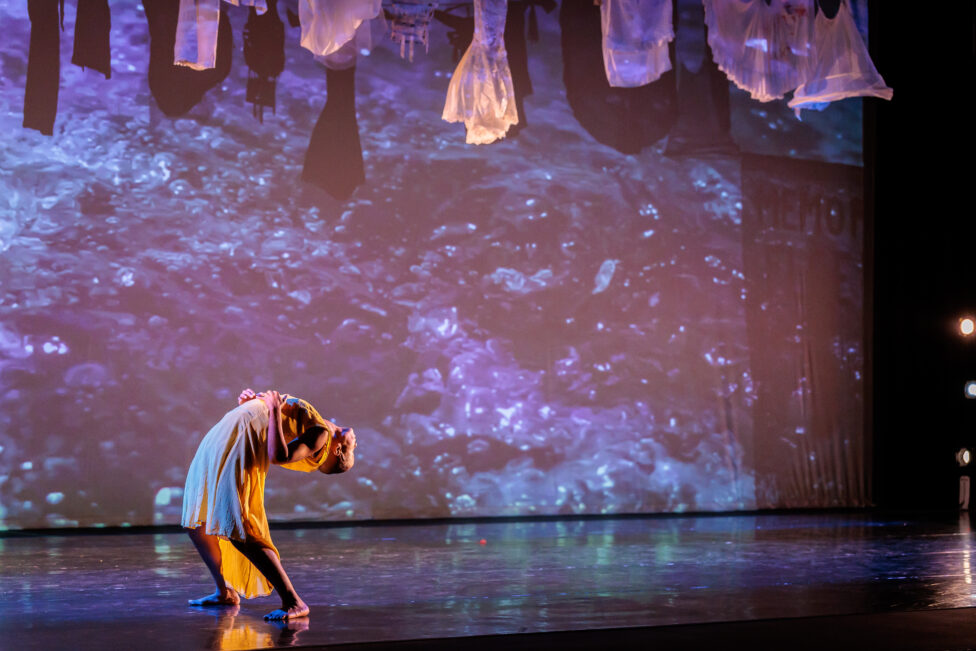
Memory Fleet: Four Pattern Jazz
Performance: Brittany Bass, Jasmine Hearn, Sydnee Houlette, Zuri Humphrey, and Natasha Manley
Direction: Jasmine Hearn
Choreography: Jasmine Hearn in collaboration with performers
In this project Memory Fleet, I’m actually returning to each person who I’ve been able to learn from, tracing many lineages that I’m part of. I just love learning so much. It’s the longest relationship I’ve been in, other than being born to the folks who I still am in a relationship with now.
From folks in the visual arts world like Tsedaye Makonnen, Alisha B Wormsley, and Holly Bass because I’ve been able to be in their work. So really, just understanding that all of the different ways of dance that I’ve learned from so many different people, the way that my mother taught me how to stir a pot from the bottom for pralines, to how she taught me how to bring two sides of skin together so the wound would heal as it’s supposed to, to the way that Jawole nurtured and challenged me. I remember that time when performing Women’s Resistance, she said, “Jasmine, I need you to drop it down even lower and arch your back just a little bit more.” So just to be with all of those different notes….
WK
During Shelter, she’s like, “Wanjiru, get down.” Another work we were doing was Soul deep to the bone. She was like, “you need to get down like Carolina.” I’m thinking, Carolina is shorter than me. I’m like, she’s already close to the ground. I have long legs. Jawole said “get to the ground quickly, like Carolina.” I will never forget it.
JH
It’s all there. And I’m just trying to understand, how do lineages want to be named? How do teachers want to be remembered? I’m really trying to connect it with practices of consent because protection is important too.
WK
Likewise, but I do have one last question. Could you share with us three people that have inspired you and are imprinted in your spirit and in your body? One person from the past, who’s an ancestor, one who’s in the living, and one who’s in the future.
JH
Wow. What a question. Yes, thank you. There were two people from the past, and that was my great grandmother, Orange Mae, and also my great grandmother, Minnie. And both of them just said, You can’t choose. You got to pick us both. And I say, Yes, ma’am. And how each one of them lived their lives. And knowing that all of the divinity that they conjured brought me into this moment, just as I am right now. I give my gratitude over and over and over again for everything they have given me. Present? You know, you say one person, and I’m like, can it be a whole constellation?
WK
Yes, we’re artists. We will go beyond the boundaries.
JH
But the incredible constellation of black womb-holding folks—folks who identify as women, folks who identify as non-binary, who, with each iterative action, said, “I did this for myself, and I also did this for others.” And I name my mother first and foremost in that and then I’m moving my arms out from the center back to the sky to really etch the multitude—the multitude of each person and our connection. As you brought in the fascia, the connective tissue, at the beginning of this conversation, all of us as individuals, but also what we build together—the quilt that we weave.
And future, I will say my niece Jackson, and how she is already spinning, moving close to the portal with divine wisdom, and I can only imagine all that she holds, and also where she wants to go. Specifically rooted in her want, as it makes sense for her body and also for her spirit. So that’s where I’m gonna hold it. I feel like I could name so many other folks, but we’d be here for three days.
WK
It’s beautiful.
JH
May I extend that question back? You have conjured the most beautiful questions. Thank you. Thank you for sharing that wisdom with us today.
WK
Thank you. Likewise. I would say ancestors would be my two grandmothers and one who I actually am named after—well, I’m named for both of them. Cũcũ, who is my grandmother from Kenya. Her name was Wanjirũ. I really didn’t know her because we didn’t speak the same language, but I would have loved to have known her. I knew her through gestures. I knew her through energy, and I knew her through a cup of tea whenever we visited her. And then my Gina Bella—my maternal grandmother. She was just a fiery, fiery, fiery being who was very planted and grounded in herself and what she wanted, and knew what she wanted and would not take any BS. She definitely had a fiery tongue. She definitely is one who inspires me to know and stay grounded and to be clear about what I desire.
I would say the living would be my mom, and then everyone else that comes out from there. It’s amazing because the older I get, I feel like I need my mom more—I desire her presence more, perhaps in my imaginary world—even more than when I was an infant. I just feel so grateful for her and grateful to witness how she lives her life. She’s caregiving for my father, who has dementia, and just witnessing the generosity and the warrior in her, is really inspiring. She was also caregiving for my grandmother, her mother, who now is an ancestor, and the example she shows of humanity, and compassion and gratitude that extends to everyone who is in her sphere, like you said, who brings that energy and that light into the world. She inspires me.
I would say for the future, all those who will take risks, all those who will do whatever it takes to make this world a better place. So not just one person, but several beings who are in the making, who are choosing to come here, and hopefully one is a niece or a nephew. We’ll see. That would be my response, yes.