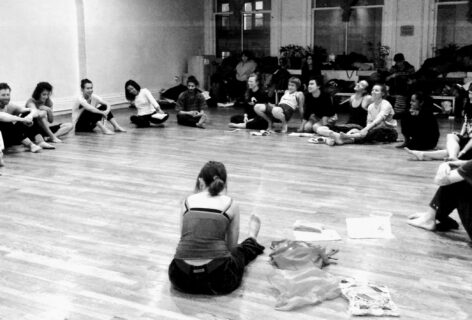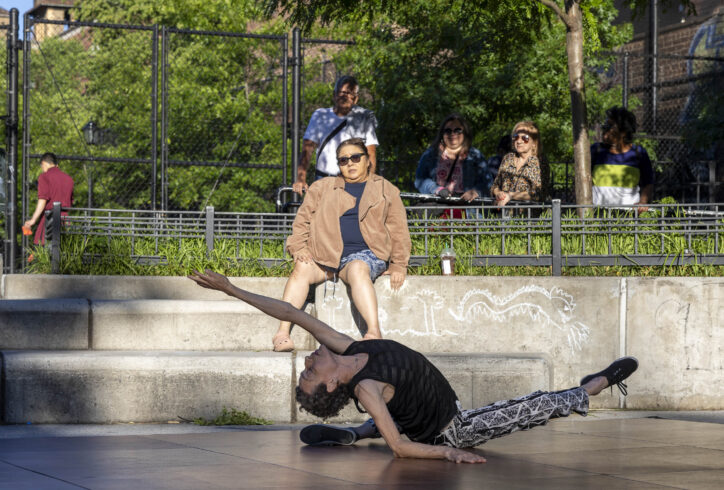
Klein Technique™ works at the level of the bone, the simplest and deepest structure in the body to work with clarity, imagery, and energy. Working on this level allows us to drop in under the layers of muscle which holds us in set postural configurations. The work we do in class focuses on deep connections of support and movement: Freeing the legs and spine, connecting the pelvis to the legs, and connecting the upper body to the lower, and the skull to the feet.
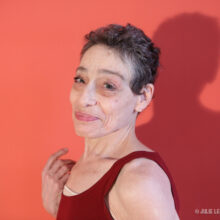
Barbara Mahler’s Klein Technique™ class always begins the same way:
Students slowly roll down until they’re completely folded over—and stay there for about half an hour. This, dancers say, is where tiny miracles happen. There’s a Zen-like calm so strong it’s palpable, as Mahler weaves through her students, gently inviting them to “bring attention to the hamstrings” or the “weight of the head to pull on the tail… it’s a way to re-educate and facilitate change—it’s knowledge for people to help themselves move better, with less pain and more ease,” says Mahler, who has been teaching it for 38 years.
Klein Technique was developed by Susan Klein in the 1970s as a response to her own injuries. Part somatic practice, part movement technique, its repetitive, slow moving approach helps students realign and re-pattern their bodies, leading to the dissolution of bad habits, a new range of motion and injury prevention.
What to expect:
A slowly paced deep investigation of movement, alone and in partners. There will be auditory instructions/cues, as well as visual ones. The movement difficulty ranges from very simple, with the possibility of slightly more complex choreographies and body use. Everything is adaptable to suit the needs of the individual.
For MELT-related questions, please email melt@movementresearch.org.
Accessibility Notes
- This workshop includes auditive guidance.
- This workshop includes printed materials.
To request ASL interpretation or Audio Description, please email accessibility@movementresearch.org, subject line “ASL/Audio Description Request, MELT Barbara Mahler” at least three (3) weeks prior to the first date of the workshop.
For access-related questions and requests, please contact accessibility@movementresearch.org, subject line “MELT Barbara Mahler.”