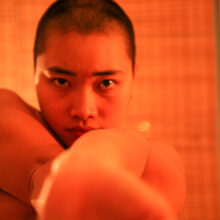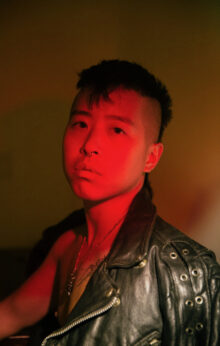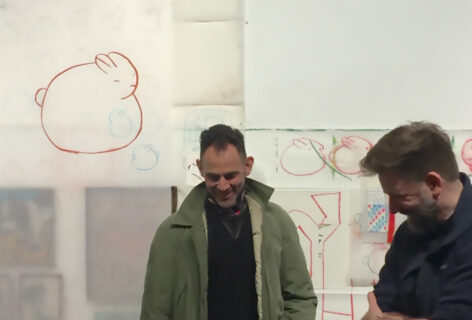
When I was introduced to Riven Ratanavanh’s practice, I was first struck by how radically personal yet so critical his writing is. He has a beautiful way of honestly reflecting his interior space – from desire to struggle – while keenly observing how the social constructs affect or inform our daily life. As we discussed about his contribution to Critical Correspondence, he proposed to have a conversation with Shannon Yu 余香儒 as a way to get to know each other more. I am honored to share a peek of that here. Although both Riven and Sha have many aspects in common—both are diasporic artists living in the U.S. and they share mutual interest for each other—we get to see the clear distinctness in each of them. In this dialogue, I’m reminded of the value and importance of the “connection through differences.”
-Takahiro Yamamoto, CC Editor
This article has been edited for the purpose of publication.
Riven Ratanavanh
I’ve been home in Thailand for the last couple months. I think in some way, I think less about transness or gender expression here. I’ve been discovering that a ton of people here just didn’t know I was trans. And of course, it’s like, Okay being read as cis is one thing, but being here has kind of rearranged my ideas about transness in some way. There’s something that is different, but not that different here, you know? In this weird way where usually I’m doing a lot of translating with general non-trans people and bodies, and then suddenly I’m realizing, wait, all that translating work I was doing sometimes doesn’t even read and doesn’t matter in the way I thought I needed to do to defend myself like in the US.
When I express gender here, I feel a little less like I have to pick and choose. I think in part because there’s a much more binary approach to gender here, but also a lot more fluidity. I just noticed that masculinity here takes on a lot more different forms. And even straight masculinity, or straight men, are much more fluid in the way they just go about their life and do things and interact with people. When I go away for a long time and I come back to Thailand, I meet certain straight men, and I’m like, Wait, are you gay? Are you kind of queer? But I’m like, wait, no, if you’re asking that question here, it just means no. It means they’re straight and they’re just normal people who don’t adhere to these American ideas of masculinity.
Shannon Yu
The cis norm here in the U.S.
RR
Yeah. There’s more flamboyance that doesn’t necessarily become a whole statement about your identity. This one thing can be flamboyant because it is. It expresses an emotion, feeling of the situation, the word, or the moment.
SY
I’m really glad you’re experiencing that because it’s very different from my experience. For me,
I feel freer in New York to express myself or just be myself in the way I am. New York people are weird enough that this place allows me to be whatever I want to be. Gender is included, but maybe also other parts, like neurodivergence or something else as well. Whereas in Taiwan, there’s definitely also a different kind of cis norm, or, just what is allowed and what is not. But overall, at least what I can see in Taipei was very homogeneous. Then again, it’s more than just gender. It’s people’s jobs, what time they’re commuting, what they’re wearing, what they’re carrying, etc. I feel very restricted there.
RR
Do you think that there could ever be a place for you artistically in Taiwan? Would you ever be interested in sharing your work there? Or is that out of the question for you there?
SY
I actually don’t know. I thought about this last year and my answer at that time was…I don’t really know. I don’t think so honestly because what I have been making is so specific to me being here [in the U.S.], and with the things I’m practicing here, with the cultural and political context that’s here. That is why my work is relevant. In order to make work in Taiwan, in Taipei, I would probably need to live there for a while. Like actually doing a residency or something. I don’t think I can just bring my work back. How about you?
RR
I guess I asked because your answer was exactly how I used to feel, and then somebody invited me to show my work last year [a work I made in the U.S.]. I felt like people were just not going to get it. Though, this was also a work that had a specific cultural anchor to Thailand, so I felt there’s at least something that could be an opening for people to connect with the work. But most of me was like, I’m gonna do this and see because for some reason, someone else [Oat Montien, who invited me to perform] believes that my work has a place here. Prior to that, I firmly believed that I had no place anywhere but New York. And then I was really surprised by the response and resonance people had with the piece. Of course, there’s older work I’ve done where it’s much more culturally, socially, and politically relevant to New York, or specific to New York that I’m sure would maybe need some translations to present in Thailand. If I look at the core of why I was making that work, the themes were issues that I’m concerned with, or things that I experienced that are still relevant here in Thailand. Before I thought they were U.S. specific, but they just take a different form here on this side of the world.
SY
Do you think that it is also related to who curated you and who was in the audience?
RR
Yes, I think so. For sure. What you say about Taiwan being quite…I don’t know if square is the word you used… or homogeneous, yeah – I definitely have heard that from another friend who just went back to Taiwan. There’s a very homogeneous gayness, but not a lot of queerness, which was their issue. It sounded like they had hoped for more, but they were disappointed. It’s interesting, I also used to feel that Thailand had gayness that was very homogenous. I felt there was this very narrow idea of how you can be gay or how you can be trans, and not much room for validity for anything beyond that. But then – I feel something has changed in the cultural atmosphere here in recent years, where there’s been a shift and more openings and less homogenous kinds of gayness and queerness. Maybe something changed fast, or maybe it was just because I started making contact with the right people, I don’t know – maybe a mix of the two. But yeah, I think definitely having that kind of curation, that kind of organizer for the event, and that kind of audience definitely changed how the piece was received.
SY
That’s actually really nice to hear. The next time I go back to Taiwan, I want to spend a good amount of time in the mountains. I do remember just feeling homogeneous and boxed in. I was feeling like a twig because I was with my family, and then with the people who looked the same. When everyone looks the same, it takes a lot of energy to be different. But I do remember when I took the train, and then as soon as we passed the tunnel outside to the mountain, I was like, The mountain doesn’t care.
RR
I deeply relate to that. It takes a lot of energy to be different. It’s a lot of stares, you know.
You mentioned breaking in your work before, and you also teach self defense. What’s the relationship between martial arts and breaking for you? Or do they feel quite separate?
SY
No, they are definitely connected: the connection between martial arts and hip hop. In the movement, it’s always marinating in my body. The main thing is to be able to express yourself, express your own unique self. So, in a way, hip hop is basically for you to channel who you are, and then from your culture and stuff. So finding the principle of the street dance is… it’s a social dance. In the social dance aspect, there’s going to be music. Because it’s a social dance and everyone has different bodies and experiences, they’re gonna look different. And that’s the beauty of it.
When I started mentioning that I practice martial arts, people were like, Oh, that makes total sense, the way that I would place my body for a freeze and stuff, and how I go through movement. So then when I’m making work, it definitely is a thing that’s together. I would go from a concept that’s from waving—like isolation—and then with Wing Chung’s other movement. I’m practicing Wing Tsun (a style of Southern Chinese Martial Arts) right now, and it has a lot of wrist movements. And then the two of them combined together. My work becomes a place where I can really allow those things to manifest themselves. How about you? Actually, I’m curious. What’s your movement practice?
RR
Oh, it’s been so weird. I don’t even know if I want to call myself a movement artist or a dancer even though I think for sure that’s how some people see me. It definitely started before transitioning. Of course I was a kid who wanted to go out and play football, basketball and sports. But sports at a certain age became gendered, and I was also a bit shy, so all of those things were obstacles. So I was just like, nope, I’m opting out. So I never thought of myself as particularly athletic, even though I wanted to be. But then, around age 17 or so, I wanted to work out. Not to get muscular, I told myself at the time, but to learn how to be strong and capable. So I did a lot of gymnastic strength type exercises and calisthenics. I was devoted to that for five or six years, building a really good base of functional strength. Eventually I was like, Oh, I just am a boy. I just want to look like a boy. And so things switched up. But there was also transition, and top surgery was the first time I really had to take a break from doing intensive lifting my body or lifting other things.
I had done some dance before that—dipped into some contemporary dance classes and some ballet classes out of curiosity. I remember when I was younger, ballet was an acceptable activity for my parents. I did ballet as a very young kid when I was four or five years old. I stopped after the trial period ended because the shoes hurt my toes. I couldn’t do it. It hurt too much. Then during the transition, I felt better to approach this again. So I dipped my toes into that, but never really got fully deep into it. But then after having top surgery and not really being able to lift things or myself, I dove back into taking movement classes of all different forms here and there as I was coming out of recovery.
SY
Your work has a way of carving out time. In the work that I’ve seen of yours, the timeline is usually longer. I haven’t really seen you “move” or “dance” in that way. Also in daily life, you’re so much more demure. I don’t really see you move, you know.
RR
So funny, because I often think of myself as a person who has to move around a lot. But it is true. For the past couple years, I haven’t really been doing any movement. When I felt like I was doing work that was most true to my voice, that’s when I started to step away from movement.
SY
I mean, you do you.
RR
I will say it’s been calling to me, but only in the right context with the right people.
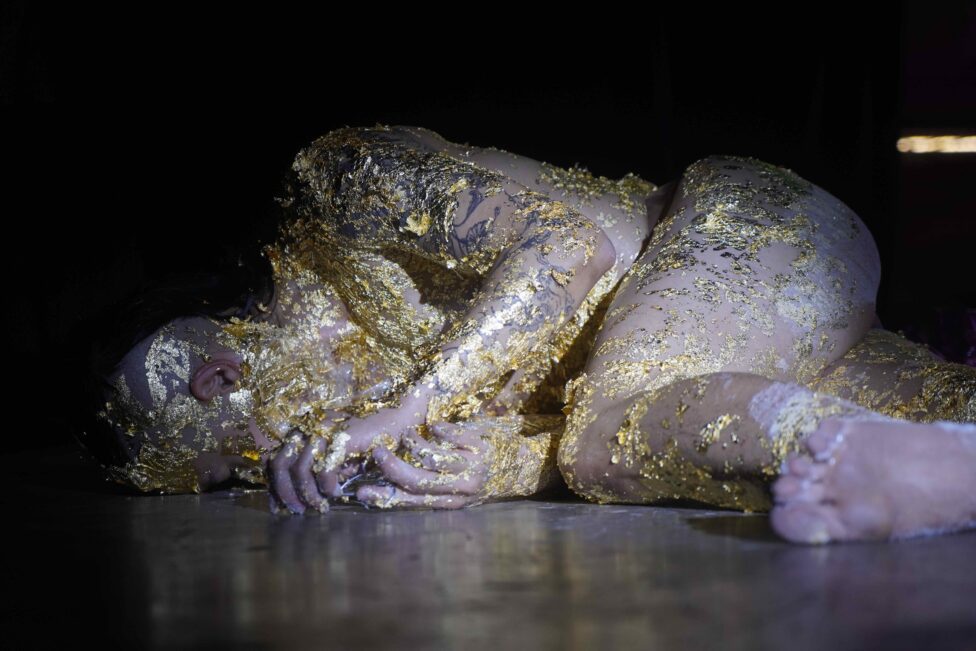
The most recent thing that I did that was more movement based was basically performing with Puppies Puppies (Jade Guanaro Kuriki-Olivo). She’s mainly been a visual artist, but she recently staged a Butoh work in Singapore. That really felt like a very different experience of doing movement work than any dance work I’ve done before. The whole process was basically us with another trans artist, Lukresia. I was like, oh, wow, maybe I only feel called to do movement work with other trans people right now. Genuinely, that was the first time when I felt really good about being in a movement piece, like I can fully be my whole self, body, and psyche, and not have to mold myself to another shape.
SY
Yeah, yeah, yeah. That just reminds me of the thing from a street dance OG, saying when dancing in the club, you lose yourself. You use the term “lose yourself” because the people around you are like you. That’s why you’re able to lose yourself. If you feel like you’re different from other people, you’re not going to be able to fully be yourself and then lose yourself.
RR
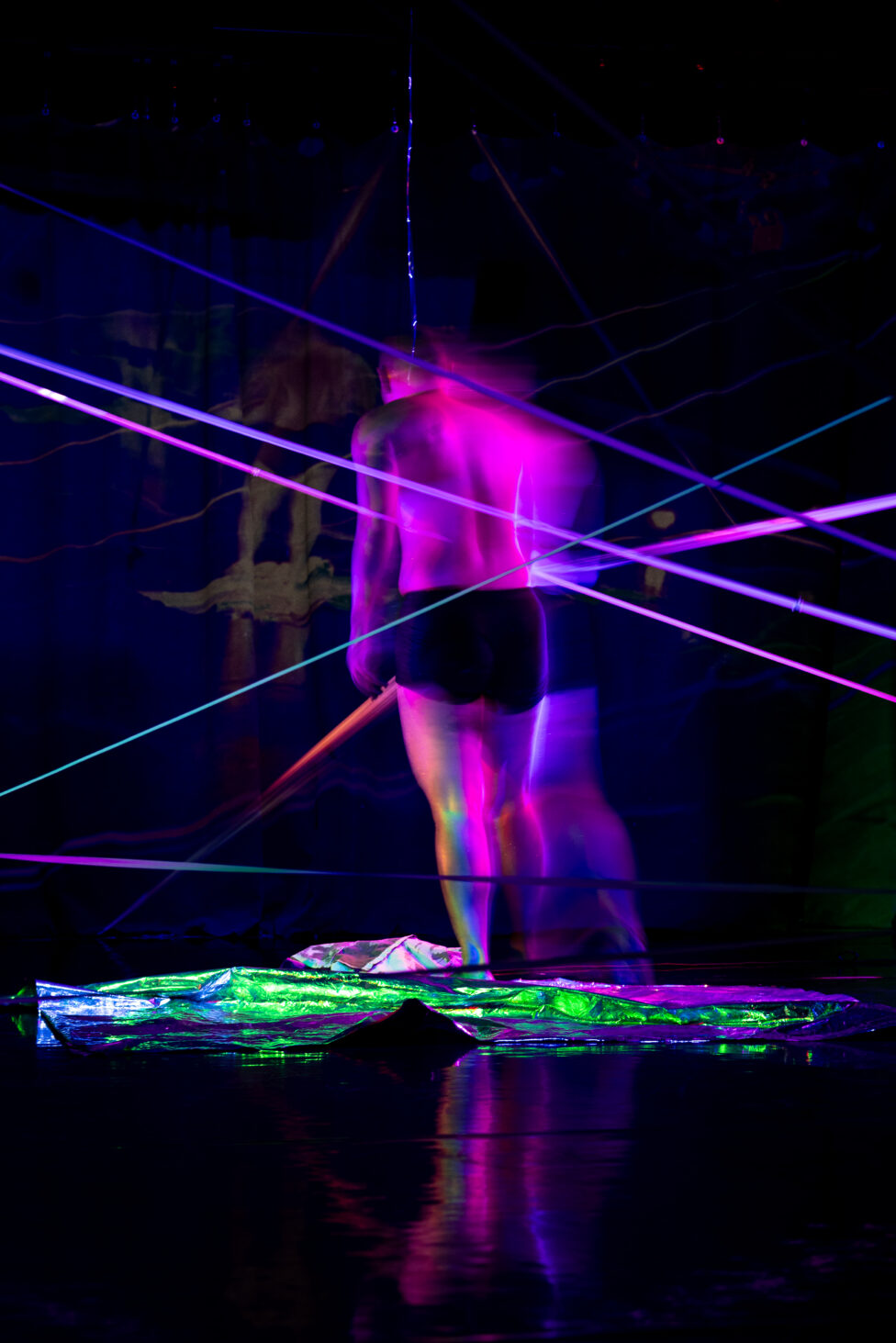
Exactly that, yeah. Also being able to trust. You’re on the same wave length. You’re in the same world, and that you don’t have to translate or just as a baseline, you’re not on different stories.
SY
You mentioned “translation” a couple times. How do you see that in your work?
RR
Maybe coming back to what you said about your work, feeling like it is very U.S.-specific right now. When I think of my work that feels very U.S.-specific, those are more performance art pieces. I feel that there were already some inherent translations going on in those works. I need to make this piece because I need to say something that hasn’t already been said, or I haven’t already expressed it: a statement about some ways in which I have experienced something that wasn’t right. The piece is basically me making those things known or more understandable to someone else who isn’t me. Not that all of my experience in the U.S. has been of not-belonging or not feeling right, but I really had some things I felt compelled to speak about these past few years because I felt not enough had been said, I guess.
SY
Recently, I have been viewing my work as a crossroads of things that I experience, like identity politics, and ideas from the universe, which is random ideas like geometry, shapes, sounds, colors, etc. Those things combined together, in a way, is a form of translation. So what I’m hearing from you is that you are taking this experience that is not being really expressed enough so people don’t really understand. But you’re also showing it through your artistic lens. So, it’s a translation in that way. I don’t think you’re making very literal art. Are you?
RR
I don’t know, but it’s still very much a staging, like a composition. But in these pieces where I feel I’m translating, it’s still not quite the same as the ones where I lose myself.
SY
I think I was telling a friend of mine. It’s like making your work explicit, but not plain—not just directly tell you what is going on.
RR
Yeah. There’s the pointedness about it somehow, but it’s not all the way out.