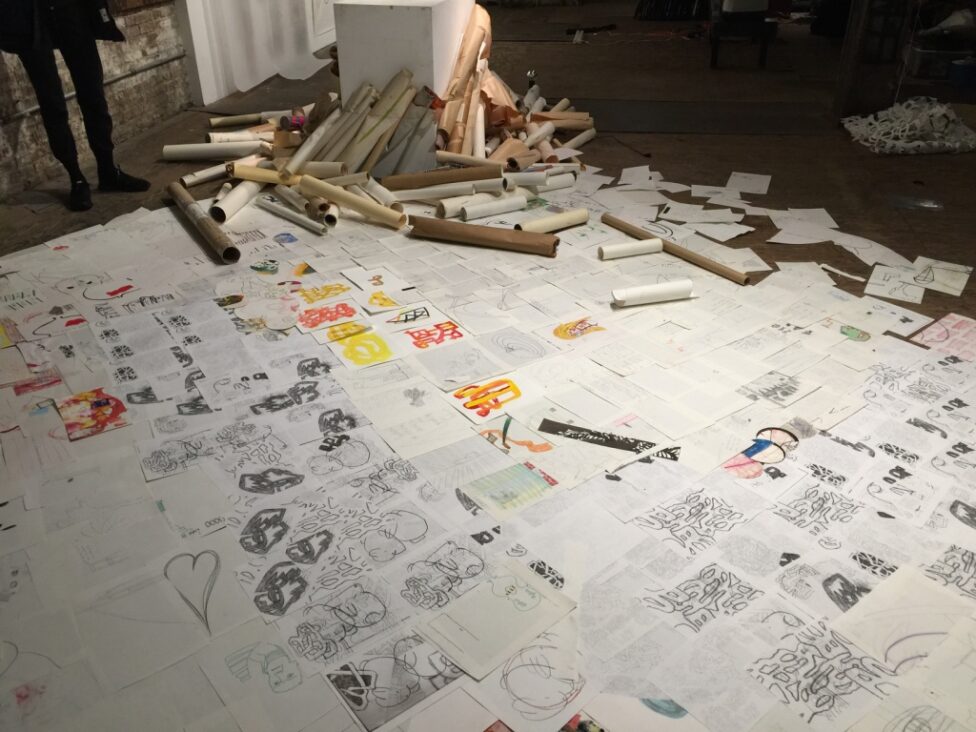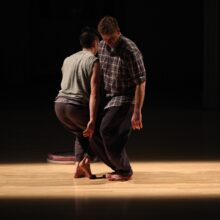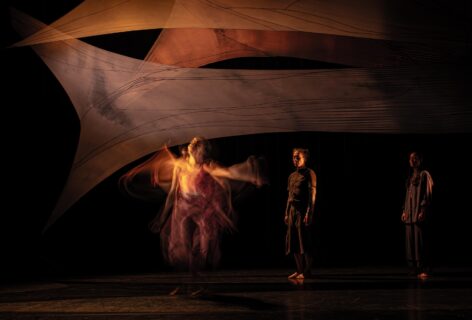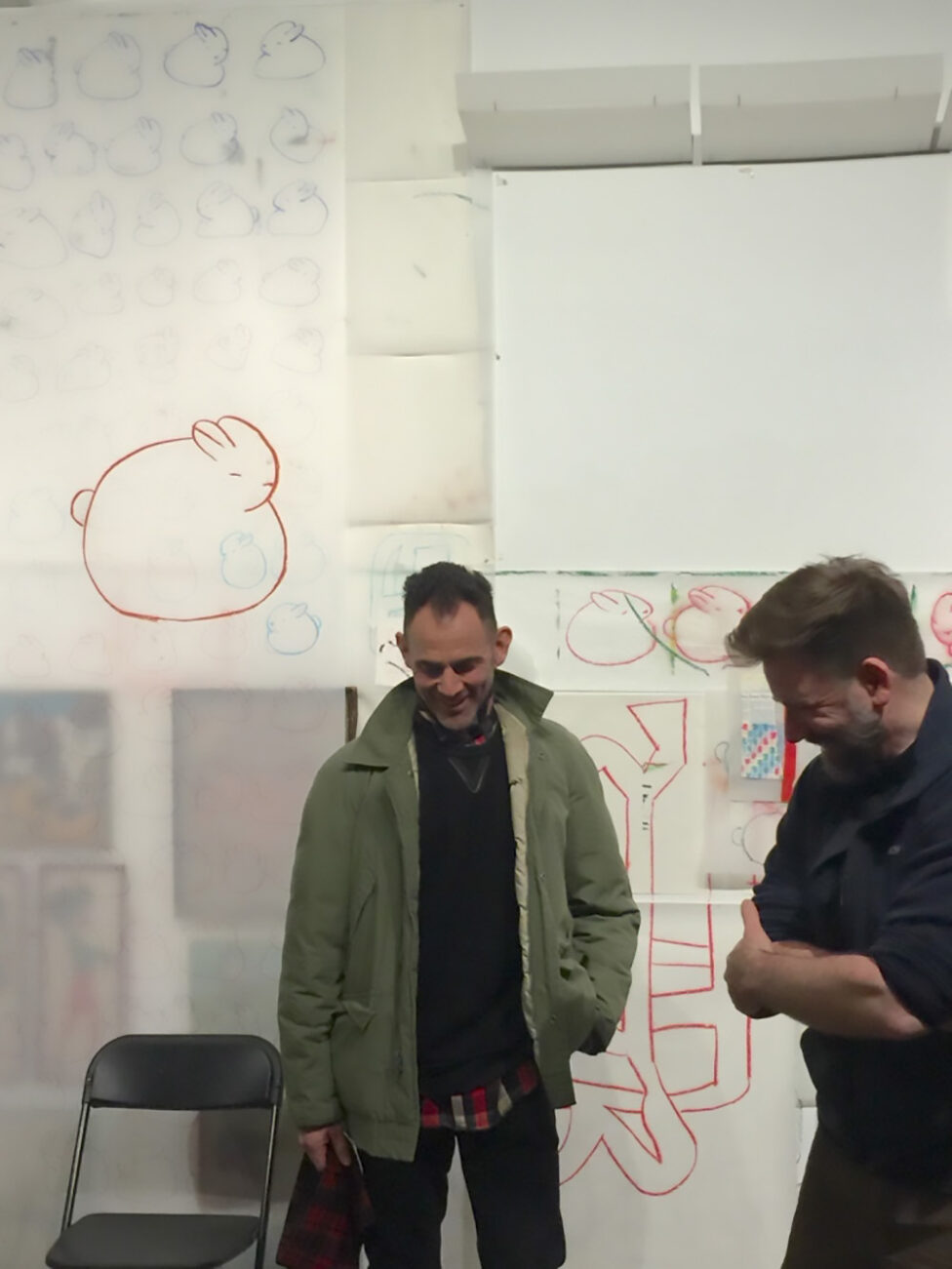
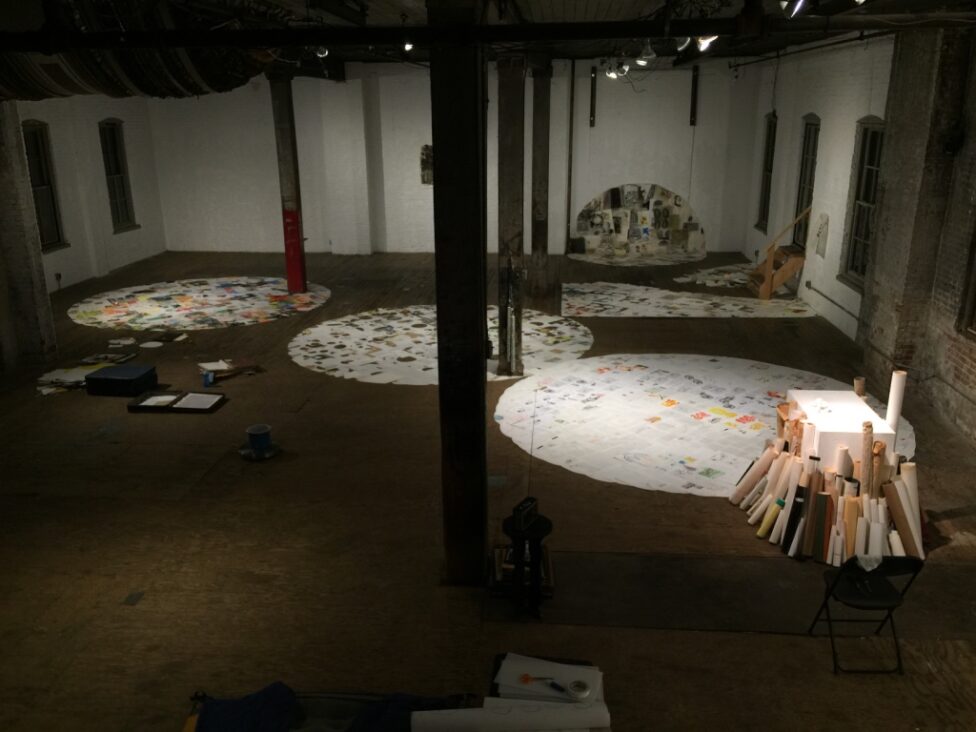
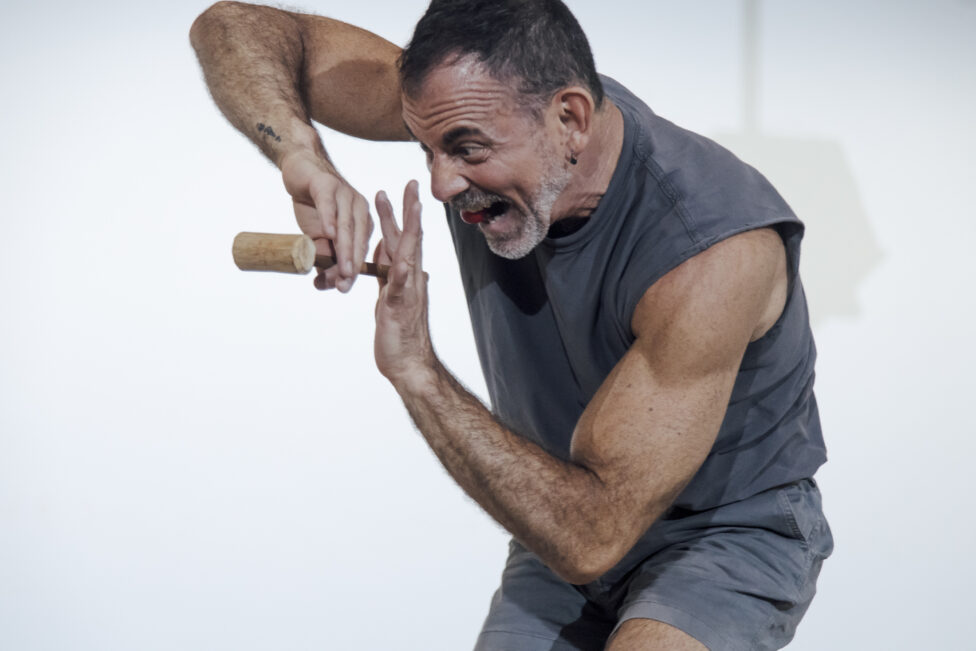
I have known Wally Cardona and Jon Kinzel for many years – so when asked to think of a conversation between two dance-artists, they immediately came into my mind. I have followed each one of these dance-artists and admired their tenacity, intricacy, commitment and perseverance. To me, their ever-growing internal landscape and its relation to the outside environment has been notable. Seeing them dance together in 2016 in Jon Kinzel’s Atlantic Terminus at The Invisible Dog (ID) etched them into my brain for eternity. Wally was one of four invited guests, one each night, to perform with Jon during the exhibition. Attending this dance with Jon and Wally at ID was like stepping into an artist studio environment: objects and drawings scattered everywhere, on walls and around the room, and the two performing bodies were in relation to all of that. It formed a connection not only between Jon and Wally but also between performance and visual art. Wally, Jon, and I met this fall in the loft of the late David Gordon and Valda Setterfield for an hour conversation that began with a discussion of them dancing together in 2016 as well as the reality of aging and dance. I felt we just started to dig a bit deeper into our communal heritage when it was time to stop. This conversation has shown me that in whatever climate we are as a society, they are surviving and continuing with their crafts, their ideas and their convictions. I am always left wanting to see more of them and their work, whether they are performances or conversations.
-Iréne Hultman Monti, CC Guest Editor
This article has been edited for the purpose of publication.
Wally Cardona
Iréne, you mentioned your memory of this creation of Jon’s, which I was a part of. It was just the two of us?
Iréne Hultman Monti
Oh, it was so amazing. I just wish I could have it rolling like a record when I don’t believe in dance anymore. You had such an intense relationship. I felt like this is male power but also female and something else. It had a range of energy. It was real and communicable. There was a generosity in that. No one was stronger or better. I was very aware that it was Jon’s space and you entered into his world. You really mastered that environment with Jon. The relationality between the two of you was electrifying.
Jon Kinzel
I asked Wally, pretty spontaneously, or rather, not spontaneously. I thought about it for a while. But there wasn’t much time spent together before the performance. We came together, and I talked a bit about some framing. I think it was the day of… I’m not sure.
WC
It was the day of, or afternoon of, and then that night it happened. I don’t remember exactly what we did, but you’ve mentioned the feeling of comfort. I remember you seeming very comfortable in your own skin, with the unknown(s), and with saying, “this is what I do know…I’m interested in these objects, these drawings, I’ve put them up on the wall and I’m comfortable with sharing them.” Of course, there were a host of other things not being talked about, but you were okay with that. And I was okay with that. In fact, probably thankful for that in some way.
JK
Yes, well, there was some framing and a part that involved a rough handling of a single blow up mattress. I thought that was sort of charged between two gay men. It was intentional to have a gay man to work with, especially Wally, because I felt comfortable with you.
I think back to the word spontaneous, and not having too much premeditated time together. It was exciting. I like to just respond – it’s not overthought or overwrought. Because of a sense of self possession, maybe you see in me something and I see that in you? I felt like I knew I could trust a feeling of immediacy between us. I always wanted to do more with you.
WC
It’s true, we could have just kept on going.
About two gay men…that’s interesting, because it’s not like it’s only possible with gay men, right? But maybe it lends itself to being able to relax some part of one’s self so there’s a kind of autonomy and freedom within that. I do remember a kind of sensuality being present.
JK
I guess you know…in as much as being Performance Art to a degree. It’s significant that you are a vehicle for the work. I’m still in my work. You’re still in your work.
WC
And when one is with another person who really has a practice…you can push them. They don’t surrender and simply give you what they think you’re asking for, especially in more improvisational situations. The person can withstand tension and keep the integrity of their own shape rather than just agreeing with you and turning into a puddle.
IHM
But do you think that your practices help to enable that resonance between the two of you? Because you have that relationship to self, within yourself. You said you trusted each other. You both have ongoing research, your own artistic self, a progress that I have observed since the 1980s-90s. That culminated in that togetherness that I saw on the internal, molecular, emotional level. It’s all connected somehow.
JK
I’ve just always admired Wally for so long. I remember the Movement Research benefit. It was at Pace University, I think?
WC
Yeah, that’s a blast from the past.
JK
It might have been your show. Yeah, that was down by the Brooklyn Bridge. You have an ability to make a lot of material that can be set –generally speaking. This one solo, I remember, almost looked improvisational because of the kind of timings and the impulses to move; it had a lot of flow, like one thing was going into the next, a kind of athleticism. There were a lot of curves.
I remember talking to you after the show. I said, “So it was improvised, right?” And then you said, “No, it’s all choreographed.” It was a nice moment where I got some insight into a masterful way that Wally can shape – like a kinesthetic master or something. His sense of flow and constant moving; it is very internal in a way, because of the orchestration of the body, knowing exactly where everything is going.
That’s something I really admired. And it was fun for me to hear you say “No, it was all choreographed.” I think you felt it was fun for you to hear that. You were like, “No.” Your solo had a freshness of seeming improvised but it was all set. That was interesting to me because it was such a specific solo artist doing something as a mover. I really admired it because it showed a way of thinking about the figure in space that, to me, could be seen through the lens of visual art and dance
IHM
So you share that kind of internal-ness that has an expression externally.
JK
Yeah, there was such a clarity of shape, the freshness of extemporaneousness, of the seemingly improvised. The clarity of what one can get at in a more iterative process of setting material.
WC
It’s always interesting how an iterative process can lead to freedom. I have memories of seeing you, I don’t remember where, maybe at Judson? And you were able to be gracious enough to not be shoving anything down my throat as a viewer. You’re doing something, there’s space for me to see it, and it’s a delicate space, with awareness and opening. You are opening to being viewed, being seen, while simultaneously having a strong internal experience.
So I’m witnessing internal happenings that are yours, not mine, but I get to have access to them. I get to see them and wonder about them and enjoy how they make themselves manifest in some way with what you’re doing.
You’re transforming the internal, giving shape to it. And how that is done… It can be practiced but it’s also a bit of a mystery.
JK
Yeah, it’s very hard to articulate.
WC
But it’s always larger than just the piece itself that one is doing. Though I’m watching a piece, I’m really seeing the breadth of that person’s lived experience. And when I’m encountering this depth and breadth… I guess that’s when I sense that the person has a practice.
IHM
I remember you, Wally, coming back from your “learning from Masters” series around the world. I’ve seen your body for so long before, and then to see the increasing sensibility and awareness in your body. The work you did afterwards has been amazing to witness. How has it affected the work that you are doing?
WC
There is something about that time… I’ve held it close and not discussed it publicly much. Probably because the experience was life changing and my words never seem to convey the largeness of it all. Trying on things I never tried on before. Showing up in front of a person who has dedicated their life to a form I know nothing about. Wanting to devote myself completely while also knowing what’s possible for me and my limited capacity, knowing that I have to navigate it all so I can still walk the next day. Traveling through physical forms and encountering endless possibilities and limitations by dancing dances which have been passed down through multiple generations over many centuries.
Just as I am and am not the same Wally when I was at 10 years old. The same could be said of me before and after those six years of work.
IHM
So your body knowledge is increasing as you are moving forward in life. How does that affect you?
WC
Yes, let’s talk about getting older! Seriously. Jon, I assume you’re getting older, too? Or is it just me?
JK
No, it’s not – it’s something I’ve been using in my blurbs and applications
WC
Ah! Age as something to leverage! One should leverage it because it’s an actual thing and I don’t think society generally looks at it as an “add value.”
The older you get, the fewer people of age are still dancing. And then there’s such a large body of work which is made for, and suited for very young sparkly bodies. So it’s what audiences are used to seeing.
These days, after I perform something, a viewer’s response is often “How old are you? It’s amazing that you’re still doing that!” That kind of vibe, you know. So even though there are more of “us” dancing now than there may have been before, many people just aren’t used to seeing an older person dance onstage.
JK
I never thought of it as “leveraging” maybe because I decided to keep my painting all these years as a parallel practice. This idea of making a series of paintings and works that are not complete and without finality in some ways feels like it mirrors the body state. The aging body is in a state of flux, with that, I mean, towards death. That’s one of the things that I was referring to about aging. That’s literally how I wrote about it.
IHM
What I see within you two is clarity. My experience of getting older is…of course you can’t jump, but you are clear. I call it crystallic. You two have different clarities in your bodies. But it is clear. It communicates. I read it.
WC
I like the word crystallization, because there are things that happen in one’s body with age and its energetic possibilities and flows. When really young, it’s glorious. Young people just sparkle and it’s gorgeous. They’re not “doing it,” it’s just emanating from them, through these qualities of fearlessness and abandonment. And while those qualities continue with age, rather than happening from the bliss of innocence and “not knowing,” the qualities become crystallized with an informed and experienced “knowing”.
It’s cool to then realize how all of those properties that were there when younger are still present, but they have changed. Fearlessness is present but it plays out differently.
IHM
Does this kind of thinking… conceptual and body thinking respond to affect? How does it affect your creative possibilities? Or does it?
JK
I had a bad car accident in 2009. So, I have steel in my leg. It was broken, and it was a mess. So, ever since then, I have a new body – speaking of not being able to jump, which happens anyway. But the accident kind of sped up or just altered my process. So that’s been a very real, concrete thing. It altered my understanding of range of motion and what’s possible.
IHM
But has it made you also go deeper into something?
JK
Yeah, sure, yeah. I think also the choice of finding the idea of refuge, of taking refuge in the body. What I was saying about youthful connection to dancing…that is still in the body, but also in the painting. I’ve kind of amped up my painting in the last 12 years. Because we’re aging, it’s something that I feel like I will be able to do more of as I hopefully continue to do more.
IHM
Time is always difficult.
JK
The time, money, all these other concerns.
IHM
The last show I saw of Jon’s at Hudson Hall was an equality between objects and dance. Equal emphasis on objects and the dancing. When you say that you’re going to do more and more painting, will the painting then be primary and the moving be a bit of a secondary situation? I’m using those words but it doesn’t mean that they are less important.
JK
I don’t think of dance as secondary, but I know what you’re saying. But no, I want to say I’ve been an artist that has a strong physical practice. I think I can say that also about you, or of Vicky [Shick]…back to the notion of crystallizing…or clarity…. I do still feel like the clarity can stem from that very physical work – as opposed to, for example, the writing that took me two months to get that much done (hand gesture denotes a few paragraphs). When you invited me for a showing here Wally, just you performing a solo, it was lovely. It was all about looking closely at the material.
WC
One-on-one…my favorite dancing set up.
JK
It was what you were preparing for Cathy’s Sundays on Broadway maybe two years ago. It was really beautiful to see you do it here [in the studio]. Why I brought that up was because I was talking about me and the visual art sensibility; looking at the body also as a conceptual matter like gender and all the other signifiers… or you know, shape. And so I feel like touching on symbolism and linguistic ideas. While I was watching you dance, I was thinking about composition and the nature of your material. I thought about your past solo work that we talked about earlier – about kinesthetic flow and athleticism. And then, this leap way ahead in time, seeing you now in an intimate setting kind of brought in a visual and linguistic component that was different in terms of shaping flow, athleticism, and the physicality shaped by your Southeast Asian masters’ knowledge.
IHM
I was just thinking that this is a different kind of athleticism right now. Being older.
WC
The crystallized athleticism of aging!
IHM
The endurance and deep passion that you both have. That’s applaudable. I think for me it is another thing that brings me to why I put you guys together. It’s something that I admire. Period. Thank you so much for this hour.